Why 3D printing has a place in yachting
A yacht is an assembly of thousands of parts, many of which were designed for a single vessel or a short run. Ten or twenty years later, the supplier of a light fitting surround or a control knob has often disappeared. 3D printing offers several concrete answers:
- Unobtainable fit-out parts on older vessels: covers, grilles, trim, knobs, cladding clips.
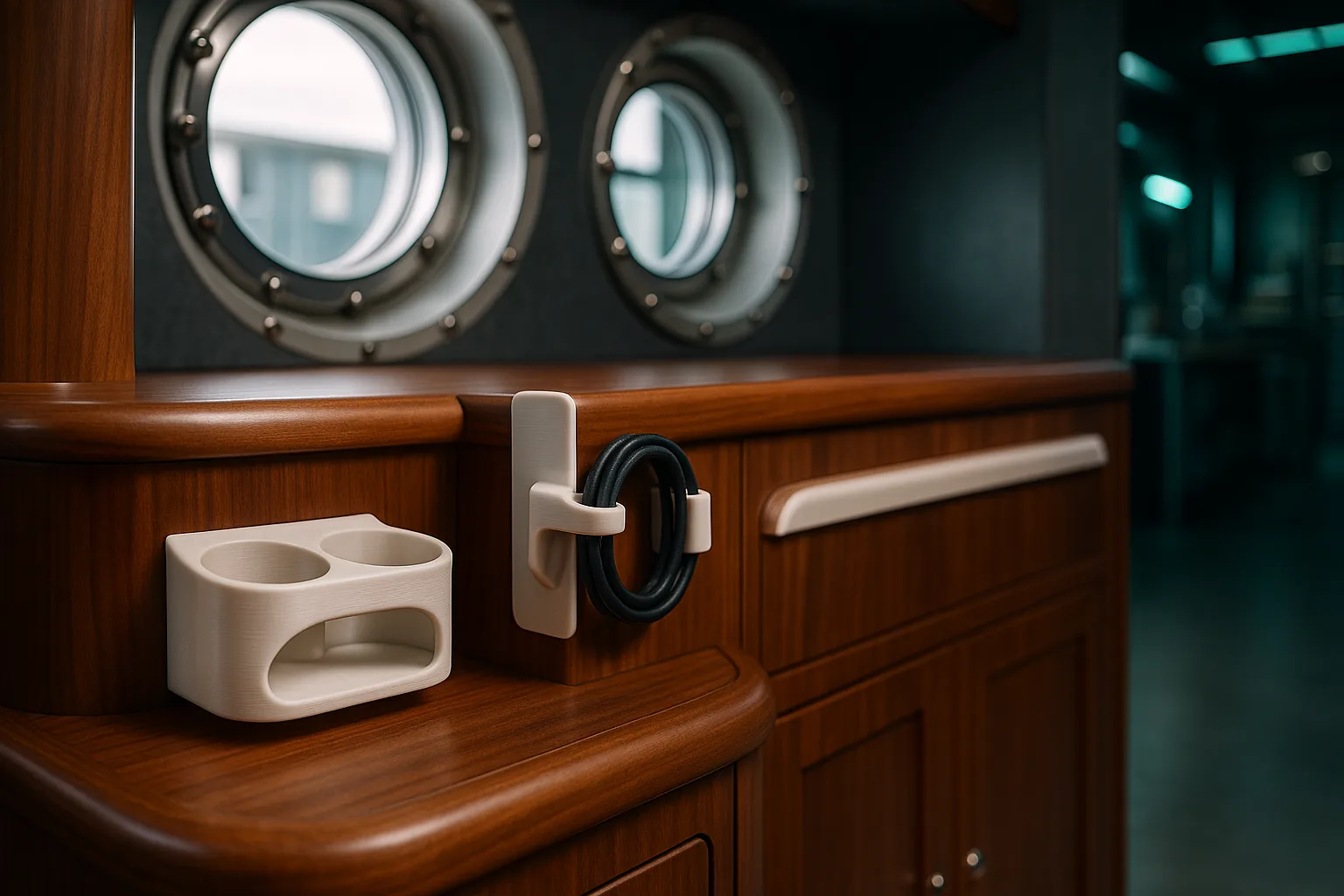
- Refit: replacing or modernising interior elements without reopening an entire piece of joinery.
- Prototypes: validating a shape, a footprint or an ergonomic design before committing to machining or final production.
- Small identical batches: the same part for every cabin on board, or for several vessels in a fleet.
- Responsiveness in season: a part missing between two charters can be remade from a file, without waiting for tooling.
Prototyping deserves a special mention. Before having a part machined in stainless steel or aluminium, or starting a casting, a printed version lets you check the actual footprint on board, access to fixings, and the ergonomics of a control. A dimensional error found on a printed prototype costs far less than a machining rework. The validated part then serves as a reference for final manufacturing, or stays as a printed part if the material and use allow it.
The general principle is described in our guide to 3D-printed spare parts; this page focuses on what's specific to yachting, starting with the level of finish.
Typical parts in refit and fit-out
| Pièce | Recommended material | Reproduction method |
|---|---|---|
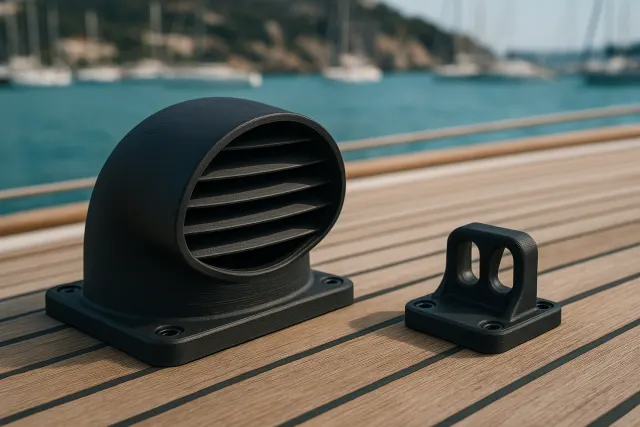
| Interior air vent or grille | ASA or PETG, painted finish | 3D scan or photos |
| Cover, trim, light fitting surround | ASA or SLA resin, painted finish | 3D scan |
| Button, dial, interior control handle | SLA resin or PETG | Photos or measurements |
| Mount for electronics, a tablet, or a remote control | ASA ou PETG | Caliper measurements |
| Cladding clip, panel fixing | Nylon or PETG | Measurements |
| Non-structural exterior deck part | ASA | 3D scan |
| Stop, guard, cupboard door seal | TPU | Measurements |
| Prototype before machining or casting | PETG, ASA ou résine SLA | Measurements, a scan, or an existing drawing |
Method A: scan the part, on site or at the workshop
Yacht fit-out parts often have elaborate shapes: curves, decorative chamfers, joins with joinery or a curved ceiling. 3D scanning is then the best method. The workshop uses an industrial Creaform MetraScan scanner, with an accuracy of around 0.1 mm. The part can be removed and brought to the workshop, and when the part or its surroundings aren't easy to dismantle, an on-site scan can be arranged case by case: mention it in your request.
A broken part can be scanned too: the fragments are digitally reassembled and the missing portion is completed by symmetry. The model is then cleaned up and its functional dimensions brought back to nominal, which corrects wear or deformation in the original. You can request a 3D scan at any time.
Use the scan as an opportunity to build a digital stock of parts for the vessel. Once the model is validated, it can be reprinted identically a year later, or for another boat in the fleet, with no new measurements needed. Remember to archive the file along with the material and finish used.
Method B: remake the part from measurements
A mount, a ring, a clip or a plate can be reconstructed very well from a few caliper measurements. Measure:
- the mounting hole spacing, centre to centre;
- the diameters of the holes, noting the original fasteners;
- the wall and tab thicknesses;
- the available depth behind a panel or in a joinery cutout.
Then describe the part in the AI 3D Studio. Timelapse's AI produces a parametric model whose every dimension is adjusted with sliders, and accepts natural-language tweaks. This is ideal for producing the same part in several sizes for different cabins. The difference with a plain mesh is explained in parametric model or mesh.
Method C: remake the part with AI from photos
For a button, dial or cover of simple shape, the AI 3D Studio can work from 1 to 6 photos: from the front, in profile, from above, with a ruler or a visible size reference in frame. The AI reconstructs the shape, then you adjust the measured dimensions. For a complex decorative part or a freeform shape that must align with a piece of joinery, scanning remains more reliable. Our guide to AI 3D modelling details the possibilities and limits.
High-end materials and finishes
Inside, the heat of a cabin closed up in the sun and the ambient humidity rule out PLA. PETG and ASA cover the majority of fit-out parts; ASA becomes necessary as soon as a part sees sun on deck or behind glazing. Nylon suits clips and working parts, bearing in mind its moisture absorption, and TPU suits stops and guards. SLA resin gives very fine detail for small visible parts. Full detail is in our guide to 3D printing materials.
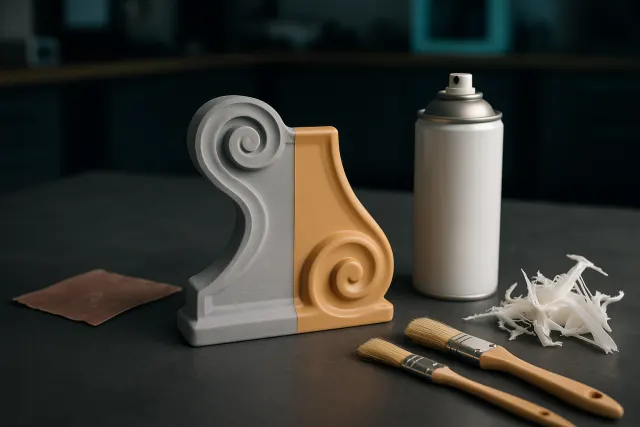
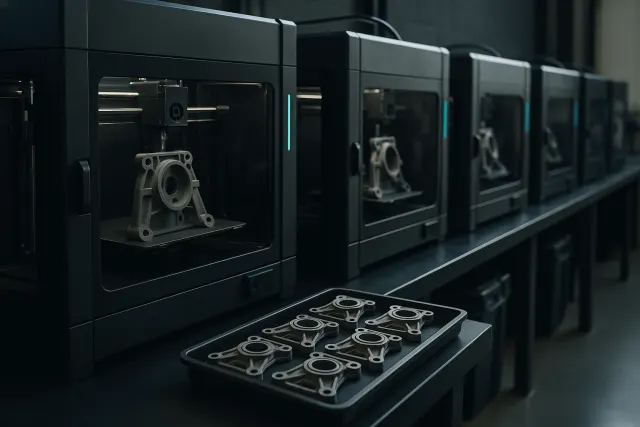
On a yacht, appearance matters as much as function. A part straight off the printer shows its layer lines; a part that's sanded, primed and painted to match the fit-out blends into its surroundings. The steps are described in our guide to finishing and post-processing. For larger parts, the workshop has a large-format fleet capable of printing up to about 60 cm, and up to 8 colours for presentation prototypes.
For a small batch intended for several cabins or several vessels, get a first part validated on board before launching the rest. A few tenths of a millimetre adjustment on a joinery cutout is easy to correct in the model, far less so on twenty parts that are already painted.
Limits and safety
3D printing in yachting covers fit-out, comfort and light fittings. It excludes:
- below-waterline parts, valves and through-hull fittings;
- rigging and load-bearing deck hardware;
- steering parts, engine control components, and structural parts;
- parts exposed to high temperatures in the engine room.
A printed part does not have the certified characteristics of an original part. The vessel's compliance and any approval requirements remain the responsibility of the owner or operator. If in doubt about a part's role, it's best to discuss it before printing: the answer often comes down to a photo of the part in place.
How to send a request from on board or from the shipyard
The workshop is based in the Var, at the heart of one of the Mediterranean's main boating and yachting hubs, and delivers across France. To start a project:
- state the type of part, its location on board, the quantity and the expected finish level;
- attach photos of the part in place and, if possible, the main measurements;
- for a simple part, generate the model directly in the AI 3D Studio, with 50 free credits and an immediate print price;
- for a complex shape, request a 3D scan.
For a shipyard or outfitter request covering several parts, a simple list is enough to get started: name, location on board, quantity, material or exposure, expected finish. Each validated part then joins the boat's digital stock, along with its print settings, allowing it to be reordered as-is the following season. The choice between FDM and resin depending on size and level of detail is explained in our guide to 3D printing technologies, and what makes up a part's cost is covered in our guide to 3D printing prices.
For a prototype before production, also see our guide to industrial 3D printing and prototyping. Boaters looking for a part for their sailboat or RIB should check our guide to boat parts in 3D printing.
Frequently asked questions
Is 3D printing suitable for a yacht refit?
Yes, for fit-out parts and light fittings: air vent grilles, covers, cladding, knobs, mounts. It allows unobtainable parts on older vessels to be reproduced, and new parts to be prototyped before machining or final production.
Can a printed part have a finish worthy of a yacht?
Yes, as long as post-processing is planned: sanding, priming and painting to match the fit-out colour. For small, highly detailed parts, SLA resin offers a finer surface finish straight off the printer.
Can the same part be produced for several boats in a fleet?
Yes. Once the model is validated, it forms a digital stock: the part can be reprinted identically in small batches, for several cabins or several vessels, with no new measurements needed.
Which yacht parts should not be 3D printed?
Below-waterline parts, valves and through-hull fittings, rigging and load-bearing deck hardware, steering, engine controls and structural parts. The vessel's compliance remains the responsibility of the owner or operator.