How the price of a 3D print is built up
The cost of a printed part breaks down into a few items, always the same regardless of the technology:
- Material consumed, including the part and supports.
- Machine time, often the biggest item: a printer tied up for ten hours on one part produces nothing else during that time.
- Preparation: checking and repairing the file, choosing the orientation, setting the parameters.
- Post-processing: removing supports, cleaning and curing for resin, any finishing work.
- Inspection and packaging, then delivery.
Each of these items depends on technical choices you can partly influence. Understanding them lets you read a quote and optimise a part before ordering it.
The factors that make the price vary
Material volume, not the overall footprint
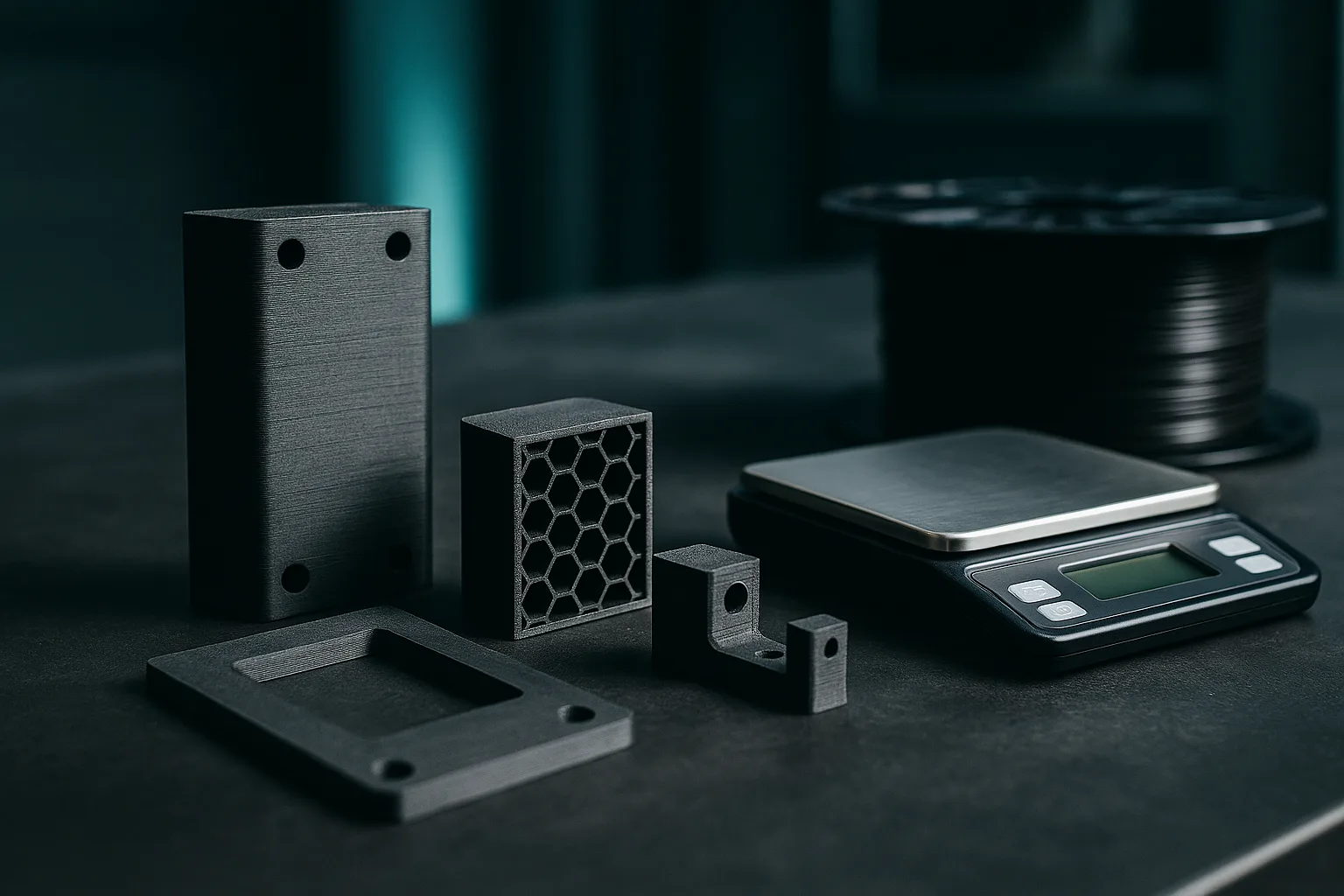
It's the volume actually printed that matters, not the bounding box. A large hollow shell can cost less than a smaller solid block. In FDM, the inside of a part is filled by a partial structure: the infill. The number of walls and the infill percentage determine the amount of material consumed.
Machine time
It depends on the volume to be deposited, but also on the height of the part: in both FDM and SLA, every layer adds time. A tall, thin part prints more slowly than you'd expect. In SLA, it's mainly the height that matters, since a whole layer is exposed at once; several parts can then share the build plate for almost the same amount of time.
Layer height
Halving the layer height roughly doubles the number of layers, and therefore the print time. Thin layers improve the look of curved and sloped surfaces, but add nothing to a hidden functional part. This is one of the most direct levers on price.
Infill and walls
Dense infill increases stiffness and mass, but also material use and time. For a mechanical part, reinforcing the walls is often more effective than increasing infill, since loads mostly travel through the periphery.
Supports
Significant overhangs require supports: material is consumed, print time increases, and manual removal time and marks to clean up follow. A well-oriented part, or one slightly modified to avoid overhangs, can cost noticeably less.
Material
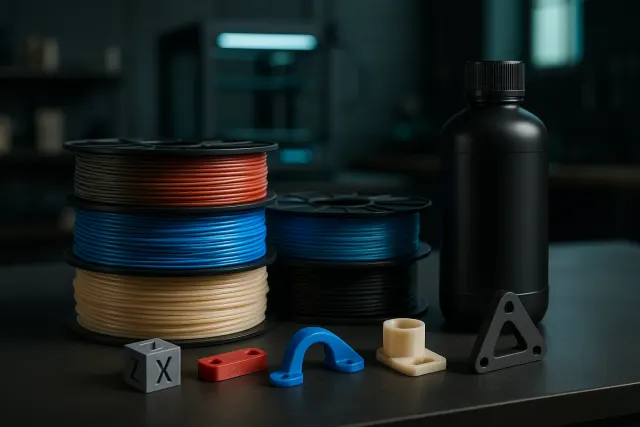
PLA and PETG are the most economical materials. Technical materials (ASA, nylon, carbon-fibre-reinforced nylon, TPU) cost more to buy and are often slower or trickier to print. SLA resins have their own cost and add washing and curing steps. The guide to 3D printing materials helps you choose the material that's just enough for the job.
Finishes
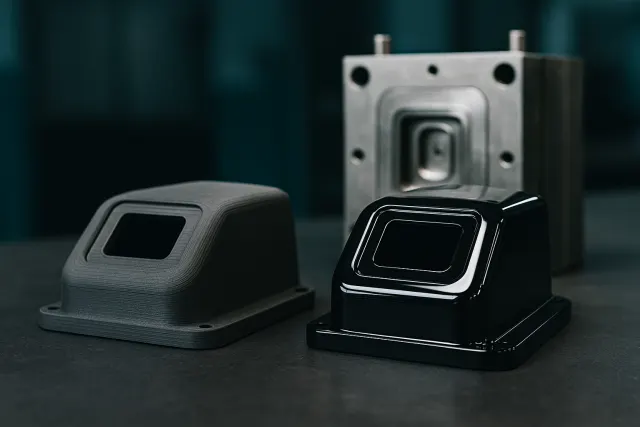
Sanding, priming, painting or fitting inserts are manual operations: their cost can exceed that of the print itself. They're detailed in our guide to finishes and post-processing. Multicolour printing can sometimes replace painting, at the cost of longer machine time (see multicolour 3D printing).
Quantity
Unit cost drops with quantity, since preparation is done once and several parts can be printed on the same build plate. That drop remains moderate compared with injection moulding, though: the machine time per part doesn't disappear. To find the threshold where a mould becomes more cost-effective, see 3D printing or injection moulding.
Urgency
An urgent order jumps the queue and can tie up a dedicated machine. Depending on the workshop's workload, this reduced lead time can come at a cost.
File preparation
A clean, watertight file at the right scale prints directly. A mesh with holes, a part that needs rebuilding, or a model to create from a sketch requires upfront work, which may or may not be billed depending on the workshop. Our guide to preparing an STL or 3MF file helps you avoid this extra cost.
Summary of cost levers
| Factor | What drives the price up | What brings it down |
|---|---|---|
| Volume | Solid part, unnecessarily thick walls | Hollowing, ribs, shell |
| Layer height | Very thin layers across the whole part | Standard layers on functional parts |
| Infill | Dense infill by default | Infill tailored to the need, walls reinforced locally |
| Supports | Many overhangs, poor orientation | Chamfers, thoughtful orientation, split part |
| Matière | Technical material that isn't needed | Material that's just enough for the use |
| Finish | Cosmetic finish on every face | Finish limited to visible faces |
| Quantity | Repeated one-off orders | Grouping parts into a single order |
| Lead time | Urgency | Planned standard lead time |
How to reduce the cost of a part
- Define the real need. A form prototype doesn't need a technical material or fine layers. Specify the function, the visible faces and the critical dimensions.
- Lighten the geometry. Replace solid masses with walls and ribs. Hollow out areas that don't carry load.
- Eliminate supports. Turn overhangs into 45° chamfers, plan for a flat face to rest on the build plate, and split a complex part into two assembled pieces if that avoids a lot of supports.
- Choose the material that's just enough. PETG covers many functional uses at a reasonable cost.
- Limit finishes to the faces that warrant them.
- Group parts together in a single order to share preparation and fill the build plates.
- Plan ahead to avoid urgency.
- Provide a clean file, or a parametric model that's easy to correct (see parametric model or mesh).
Before ordering a run, have a single part printed and validate it under real conditions. You'll often discover that a wall can be thinned or a finish is unnecessary: the savings made on the run far outweigh the cost of this test part.
Getting a price for your part
Because the price depends on all these parameters, it's calculated from the part's actual geometry rather than from a generic price list. Two cases arise:
- Part generated or adjusted in the Studio: when you order a print from the AI 3D Studio, the price is calculated instantly online based on the chosen model, material and quantity. You can change a dimension and see the effect immediately. Models from the parametric library work the same way.
- Specific project: large parts, production runs, special materials, finishes, scanning and reverse engineering are quoted by the workshop.
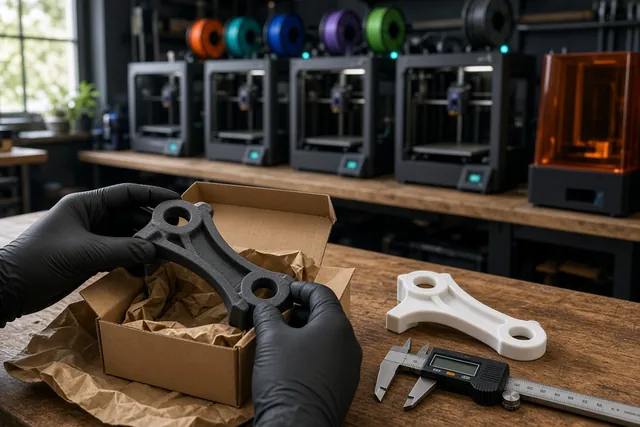
Timelapse-3D's workshop, based in the Var region of France, prints on more than twenty FDM and SLA machines running 24/7, with delivery across France. For a quote request, send the file, the desired material, the quantity, the expected finish and your deadline: these are exactly the pieces of information that determine the price.
Pitfalls to avoid when comparing quotes
- Comparing different parameters: two quotes for the same part may be based on different layer heights, infill levels or materials. Check that they describe the same finished part.
- Overlooking post-processing: a low price may correspond to a raw part, with supports left for you to remove yourself.
- Neglecting delivery and lead time, which are part of the real cost for an urgent project.
- Thinking in terms of weight alone: weight reflects the material, not the machine time or the labour.
To go further on choosing the right process for your part, see the guide to 3D printing technologies.
Frequently asked questions
How is the price of a 3D print calculated?
The price adds up the material consumed, machine time, file preparation, post-processing and delivery. Machine time is often the main item. It depends on the volume, the height of the part, the layer height and the supports.
Why can a small part be expensive to print?
Because cost doesn't depend only on size: very thin layers, numerous supports, a technical material or manual finishing all push the price up sharply. A fixed amount of preparation and handling also applies to every order, regardless of the part's size.
How do you reduce the price of a 3D print?
Lighten the geometry with walls and ribs, orient or modify the part to avoid supports, choose a material that's just enough, and limit finishes to visible faces. Grouping several parts into a single order and avoiding urgency also reduces the cost.
Can you get the price of a 3D print online?
Yes, when the part is generated or adjusted in the AI 3D Studio, the price is calculated instantly based on the model, material and quantity. For specific projects, such as large production runs, finishes or reverse engineering, the workshop provides a quote.