Why 3D printing for a classic car
On a collector vehicle, the mechanicals can often be rebuilt more easily than the small interior parts. Plastics, bakelite and early thermoplastics have aged: they yellow, crack, become brittle. And stocks disappeared long ago. 3D printing offers an answer in several situations:
- Unobtainable part: no reproductions made, rare used parts that are expensive or themselves damaged.
- Low production volume: a model made in small numbers, a market variant, a special series.
- Small batch for a club: a part measured once can be reprinted for several members, with no mould or tooling.
- Display part: completing an interior for a rally or exhibition while waiting for a period-correct part.
For modern vehicles, see our guide to automotive parts in 3D printing, and for the general method, the one on spare parts.
The parts reproduced most often
| Part | Recommended material | Reproduction method |
|---|---|---|
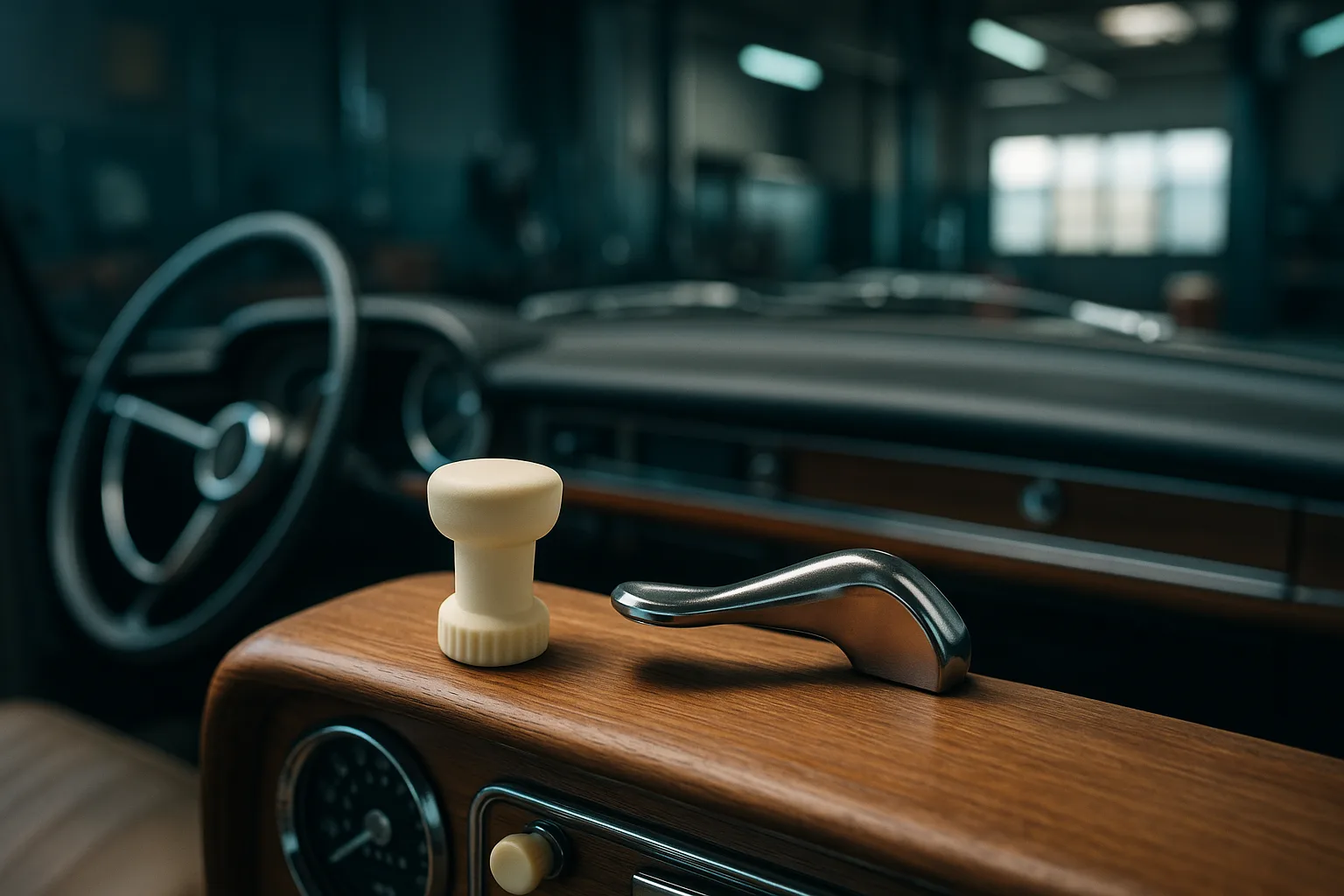
| Dashboard knob, pull switch | Résine SLA, ASA | Scan |
| Window-winder handle, crank | Nylon, ASA | Scan, plus measurements for the splined shaft |
| Trim ring, surround, moulding | ASA | Scan |
| Speaker grille | ASA, PETG | Scan or measurements |
| Logo, emblem, monogram | Résine SLA | Scan |
| Cap, plug, blank | ASA, résine | Measurements or photos |
| Interior part: door pocket, ashtray, mount | ASA | Scan |
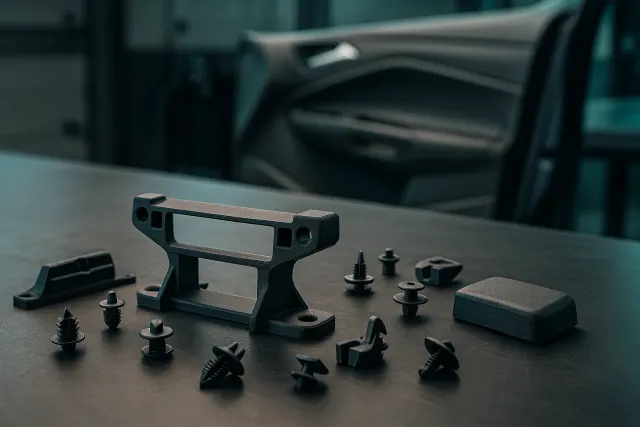
| Trim clip or fastener | Nylon, PETG | Measurements |
Chrome-plated metal parts (logos, trim rings) can be reproduced in plastic and then painted for a metallic look, but the appearance and durability aren't those of a metal part: it's a choice to make with full knowledge of the trade-off.
Method A: scan the part, even a borrowed one
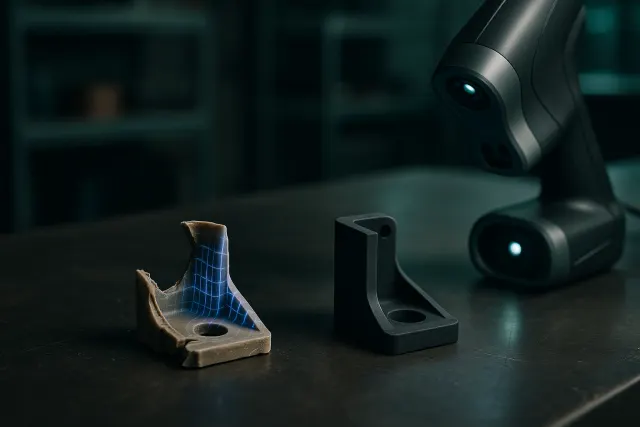
On a classic car, 3D scanning is the method of choice. Period shapes are rarely geometric: curved knobs, decorative ribs, embossed lettering. The workshop uses an industrial Creaform MetraScan scanner, with an accuracy of around 0.1 mm, which captures these details.
Scanning doesn't require sacrificing a part. A club member or another collector can lend a part in good condition: it's scanned without being altered, then returned. A broken part can also be used: the pieces are glued back together before scanning, or the missing portion is reconstructed by symmetry.
Correcting wear and shrinkage
A fifty-year-old part no longer has its original dimensions. The scan reproduces worn edges, deformation and material shrinkage. The reconstruction stage brings functional features back to size (shaft, hole, snap-fit) and cleans up the surfaces, while keeping the original design. The corrected model can then be used for a small batch for the club. Request a scan via the 3D scan page.
From scan to small batch for the club
The usual process is simple: a reference part is scanned, the model is corrected, a first unit is printed and fitted for validation, then the batch is launched. If two model years of the same part show a variant (a different shaft diameter, a modified logo), the corrected model can be produced in two versions rather than scanning a second part. The validated file stays available: when a new member joins the club with the same need, printing simply resumes. For larger parts, such as a dashboard surround, the workshop's large-format printing produces up to about 60 cm in one piece, avoiding visible joints.
Method B: remake the part from measurements
For a simple part (cap, spacer, plug, clip, plate), calipers are enough. Measure:
- the hole spacing of fixings and centring pins;
- the diameters of shafts, holes and shoulders;
- the wall and flange thicknesses;
- the shape and number of splines on a control shaft, counting the teeth.
Describe the part in the AI 3D Studio with these measurements: it produces a parametric model whose every dimension is adjusted with sliders. This is useful when the part on another club member's vehicle differs slightly. The clearances to plan for a snug fit are detailed in our guide to tolerances and fits, and the difference between a parametric model and a scanned mesh is covered in parametric model or mesh.
Method C: remake the part with AI from photos
When the part is gone and only a photo of another vehicle remains, or for a simple shape, Timelapse's AI can reconstruct the part from 1 to 6 photos. Take them from the front, in profile and from above, with a ruler or an object of known size in frame. The AI proposes a shape; you then adjust the dimensions with sliders or through natural-language tweaks.
This method suits simple caps, plugs or knobs. For an emblem, lettering or a complex decorative shape, the fidelity expected on a collector car calls for scanning. Our guide to AI 3D modelling details what the AI can do and its limits.
Before launching a batch for the club, print a single unit and fit it to two or three different vehicles. Period tolerances varied from one unit to another; it's better to adjust the model once than to redo ten parts.
Materials and finishes for an authentic look
On a classic car, looks matter as much as function. The choice of material takes into account the heat of a cabin in the sun (PLA should be avoided), UV behind the glass, and contact with hands:
- ASA: interior and exterior parts, good heat and UV resistance, sands and paints well.
- SLA resin: fine details, lettering, emblems, patterned knobs. Smooth surface, ideal before painting.
- Nylon: stressed mechanical parts such as cranks or control shafts.
Finishing steps
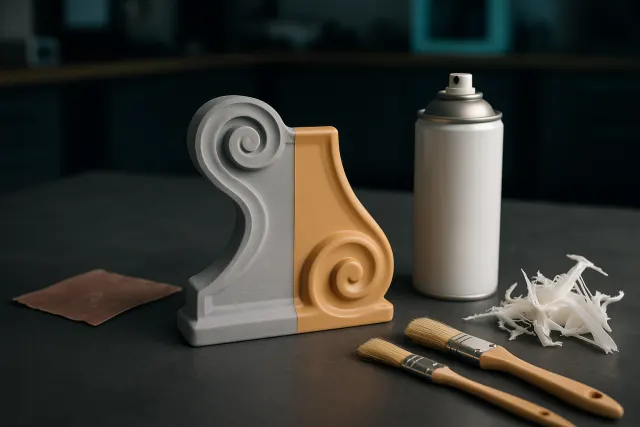
To recreate the look of bakelite or a period plastic, the part goes through sanding to erase the layer lines, a filling primer, then paint in the desired colour and sheen. The raised details of an emblem can be highlighted with a second colour. These steps are described in our guide to finishing and post-processing, and the materials available are on the materials page. Our guide to 3D printing materials compares their properties.
Authenticity, limits and safety
Respecting authenticity
A printed part is a functional replacement, not an original part. For the value and history of the vehicle, disclose it during a sale or an appraisal, and keep the original part if possible, even if damaged. Some clubs even choose to discreetly mark their reproductions on a hidden face.
Parts that should never be printed
Do not print braking, steering, suspension and chassis parts, restraint components (seatbelts, seat mounts), fuel and brake circuit parts, structural parts, approved headlamps and lighting or signalling devices, or helmets and protective equipment. The vehicle's compliance, its approval and its roadworthiness inspection remain the owner's responsibility.
How to send a request
- Decorative or complex part: request a scan via the 3D scan page and send the part (yours or a borrowed one) to the workshop in the Var. It's returned after scanning.
- Simple part: use the AI 3D Studio with your measurements or photos, adjust the model and order the print with an immediate price. The 50 free credits let you make your first attempts.
- Batch for a club: specify the number of units, the desired finish and any variants by model year.
State the make, model, year, the part's location, in-place photos and, if you have any, period photos. With more than 20 machines (multi-material FDM, SLA resin, large format up to about 60 cm), the workshop delivers across France. To budget, see our guide to 3D printing prices; classic motorcycles have their own guide: motorcycle parts in 3D printing.
Frequently asked questions
Can a bakelite part be reproduced in 3D printing?
Its shape is reproduced, not its material. The part is scanned, corrected, printed in ASA or resin, then sanded, primed and painted to recreate bakelite's look and sheen. The feel and weight remain slightly different from the original.
Can a part lent by another collector be scanned?
Yes. 3D scanning doesn't damage the part: it's captured as-is, then returned intact. The resulting model is then corrected for wear before printing, which allows one or more copies to be made from it.
Does a printed part reduce the value of a collector car?
It remains a functional replacement part and should be disclosed as such during a sale or an appraisal. Keeping the original part, even if damaged, and discreetly marking the reproduction on a hidden face are good practices.
Can a small batch be made for a club?
Yes, that's one of the great benefits of 3D printing: once the model has been corrected and validated on a first unit, it can be reprinted as many times as needed, with no mould or tooling.