The criteria that really matter
The question "what is the best material?" has no universal answer. A material is chosen based on the stresses the part will undergo. In the workshop, we systematically review five criteria:
- Operating temperature: a thermoplastic starts to soften as it approaches its glass transition temperature (Tg). A part in a vehicle in full sun can exceed 70 °C.
- UV and outdoor exposure: some plastics yellow, become brittle or warp within a few months.
- Mechanical stresses: static load, impacts, repeated flexing (clips, hinges), friction.
- Chemical environment: oils, fuels, solvents, cleaning products, humidity.
- Appearance and precision: smooth surface, fine details, colour, transparency.
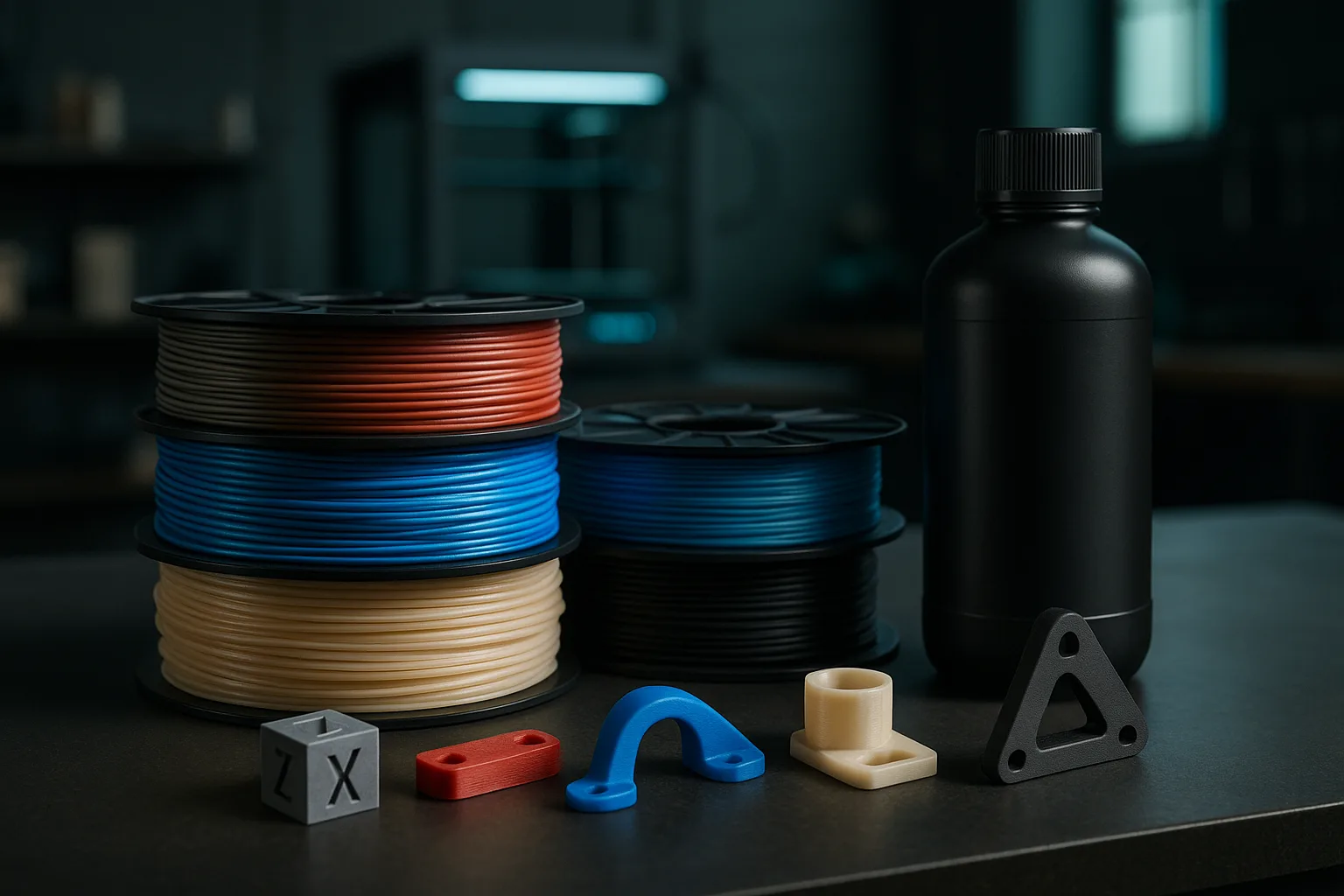
The material also depends on the technology: filaments are reserved for FDM, resins for SLA/MSLA processes, powders for SLS and MJF. If you're still unsure about the process, start with our guide to FDM, SLA, SLS and MJF 3D printing technologies.
Common filaments: PLA, PETG, ABS and ASA
PLA: easy, precise, but heat-sensitive
PLA is the easiest filament to print: little shrinkage, very little warping, crisp details, a wide colour range. It is rigid and fairly strong in tension, but brittle on impact. Its main limitation is thermal: its Tg sits around 60 °C. A PLA part left behind a windshield in summer will warp. Reserve it for appearance prototypes, mock-ups, indoor objects and lightly loaded jigs.
PETG: the everyday all-rounder
PETG offers a good compromise: tougher than PLA (it bends before it breaks), better heat resistance with a Tg of around 80 °C, good resistance to moisture and many chemicals. It suits mounts, enclosures, indoor technical parts and many spare parts. Its surface is a little glossier and it tends to string slightly.
ABS and ASA: heat and outdoor use
ABS and ASA have a Tg of around 100 °C. They handle heat and impact well, and sand or smooth easily. ASA adds very good UV resistance: it is our first choice for parts exposed outdoors. Both require an enclosed, heated chamber when printing, since they shrink as they cool and can warp off the plate or crack between layers.
Technical filaments: TPU, nylon and composites
TPU: flexibility
TPU is a thermoplastic elastomer. Depending on its hardness (commonly 85A to 98A on the Shore scale), it ranges from soft rubber to semi-rigid plastic. It is used for seals, dampers, protective covers, soles, non-slip grips. It absorbs impact very well and resists abrasion. It prints slowly and tolerates very fine geometries or long bridges poorly.
Nylon (PA): toughness
Nylon (PA6, PA12) is strong and tough, with good behaviour under friction and fatigue. It is the material of choice for gears, slides, hinges and heavily loaded clips. It absorbs ambient moisture: the spool must be dried before printing, and the part's properties shift slightly with humidity.
Fibre-filled composites
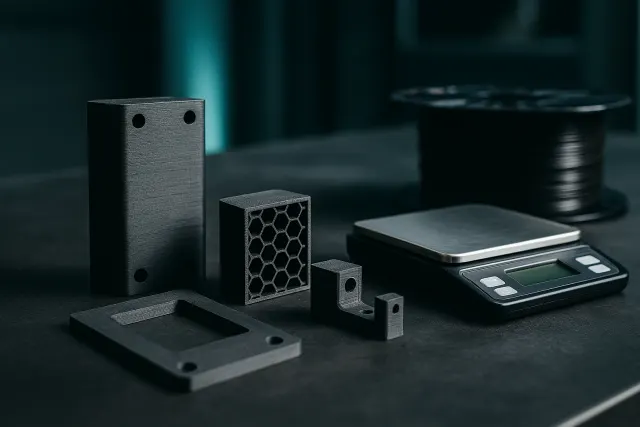
Filaments filled with short carbon or glass fibres (PETG-CF, PA-CF, PA-GF…) gain noticeably in stiffness and dimensional stability, with a matte look that hides layer lines. In exchange, they are more brittle in flexing and abrasive: they require a hardened-steel nozzle. They are highly valued for workshop jigs and tooling that need to stay rigid and precise.
Resins and powders
In resin printing, a distinction is made between:
- Standard resins: excellent detail rendering, smooth surface, but brittle and UV-sensitive over the long term. Ideal for figurines, mock-ups and visual prototypes.
- Technical resins: "tough" or ABS-like (better impact resistance), high-temperature, flexible, transparent. They bring resin closer to functional use, without matching sintered nylon in fatigue resistance.
- Castable or burnout resins: for jewellery making and lost-wax casting.
In powder sintering (SLS, MJF), PA12 dominates: good mechanical properties, nearly isotropic, good chemical resistance, matte surface. PA11, which is more ductile, and powder TPU round out the offering. These materials suit small batches of functional parts, as explained in our guide on prototyping and small batches.
Material comparison table
| Material | Heat resistance (indicative Tg) | Impact resistance | UV / outdoor | Ease of printing | Typical uses |
|---|---|---|---|---|---|
| PLA | ~60 °C | Low | Medium | Very easy | Appearance prototypes, mock-ups, decor |
| PETG | ~80 °C | Good | Fair | Easy | Enclosures, mounts, spare parts |
| ABS | ~100 °C | Good | Low (yellows) | Tricky (enclosure needed) | Hot-area parts, housings, parts to be smoothed |
| ASA | ~100 °C | Good | Very good | Tricky (enclosure needed) | Outdoor parts, automotive, signage |
| TPU | Variable | Excellent | Fair | Slow | Seals, dampers, protective covers |
| Nylon (PA) | High | Very good | Fair | Tricky (drying needed) | Gears, hinges, clips |
| CF/GF composites | Depends on the matrix | Medium | Depends on the matrix | Medium (steel nozzle) | Rigid jigs, tooling |
| Standard resin | Low to medium | Low | Low | Post-processing required | Figurines, fine details |
| Sintered PA12 | High | Very good | Fair | Industrial process | Small functional batches |
Tg values are indicative and vary by manufacturer formulation. A part can deform under load slightly below its Tg: keep a margin of at least 15 to 20 °C.
Reading a filament technical data sheet
Manufacturer data sheets give values measured on standardised test specimens, often printed at 100% infill and in the most favourable orientation. A real part, with its walls, partial infill and differently oriented layers, will perform less well. Focus mainly on three indicators:
- Heat deflection temperature (HDT): more meaningful than Tg for a part that works under heat.
- Impact resistance (Charpy or Izod): it distinguishes a tough material from a brittle one, at comparable stiffness.
- Elongation at break: a material that stretches a lot gives warning before breaking, which is valuable for clips and fasteners.
Always compare values from the same standard and, for a critical part, validate with a real-world test rather than relying on the data sheet alone.
Choosing based on your application
- Prototype to validate a shape or footprint: PLA, fast and precise.
- Indoor functional part (mount, enclosure, fastening): PETG.
- Part exposed to sun or outdoors: ASA.
- Hot-area part (near a motor, a light source): ASA or ABS, nylon for more margin.
- Part that rubs, fits or clips frequently: nylon, or sintered PA12 for a production run.
- Flexible or cushioning part: TPU, choosing the appropriate hardness.
- Figurine or highly detailed part: resin, or multicolour PLA if colour matters most, see multicolour 3D printing.
For a spare part, look at the original material (often stamped on the inside: PA, ABS, PP, POM). If the original part was polypropylene or POM, materials that are hard to print, nylon or PETG is generally the best substitute. Our guide to 3D-printed spare parts details the approach.
Common mistakes and best practices
- Defaulting to PLA for a functional part: this is the leading cause of parts that warp or break in use.
- Neglecting orientation: even the best material stays weak between layers if the load is poorly oriented.
- Forgetting shrinkage: ABS, ASA and nylon shrink more, which affects dimensions; account for it with our guidelines on tolerances in 3D printing.
- Ignoring food contact: no FDM part is simply "food-safe"; the ridges trap bacteria, and compliance depends on the material, the additives and the process. Ask for advice before any use of this kind.
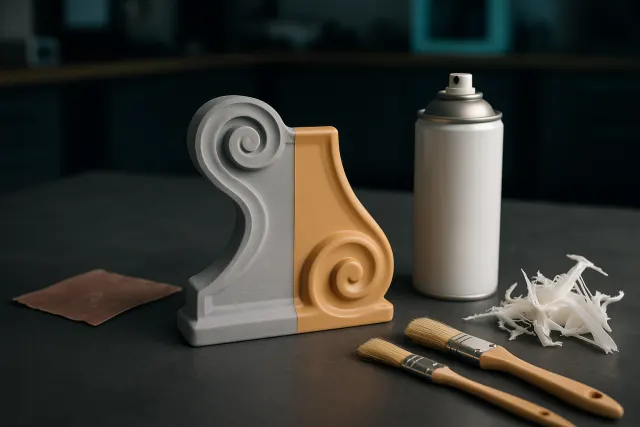
- Underestimating post-processing: sanding, priming, smoothing or thread inserts change the look and the strength. See our guide to finishing and post-processing.
Our workshop in the Var prints in multi-material FDM and SLA resin; you can check the materials offered by the workshop and specify the part's intended use in your request so the material is validated before printing.
Frequently asked questions
What is the strongest filament for 3D printing?
For toughness and fatigue resistance, nylon (PA) and its fibre-filled versions are among the best performers in FDM. For everyday use, PETG offers a good compromise between strength and ease of printing. The right choice, however, depends on the type of load, the temperature and the environment.
PLA or PETG: which one to choose?
PLA is easier to print and more precise, ideal for appearance prototypes and indoor objects. PETG withstands heat better (around 80 °C versus 60 °C), as well as impact and moisture. For a functional part, PETG is generally the safer choice.
Which 3D printing material resists UV and outdoor exposure?
ASA is the go-to filament for outdoor use: it holds up well against UV, weather and heat up to around 100 °C. ABS withstands heat but yellows and becomes brittle in the sun. PLA and standard resins are not recommended for prolonged outdoor use.
Is a resin-printed part strong?
Standard resins are precise but rather brittle, and suited to appearance parts. Technical "tough" resins noticeably improve impact resistance. For a heavily loaded part, a technical filament or sintered nylon generally remains more reliable.