Why 3D printing for a motorcycle or scooter
On a two-wheeler, plastic parts are exposed: a tip-over at a standstill cracks a cover, vibration shakes loose a plug, the sun cracks a fairing. 3D printing is relevant in several cases:
- Discontinued reference: the manufacturer no longer supplies the part, or only as part of a whole bodywork assembly.
- Lead time: the motorcycle is off the road for a small part ordered from abroad.
- Older models: classic motorcycles and scooters whose plastics no longer exist. For cars, see the guide to classic car parts.
- Prep and custom work: custom covers, accessory mounts, adapter plates that the market doesn't offer for your machine.
Scooters are particularly affected: their bodywork is made of numerous small clipped-in parts (flaps, glove boxes, fork covers, instrument surrounds) whose fixing tabs eventually break after a few removals. Rather than replacing a whole assembly, only the damaged element is remade, reinforcing the fragile tabs along the way.
The general approach is detailed in the guide to 3D printed spare parts.
The motorcycle parts most often printed
| Part | Recommended material | Reproduction method |
|---|---|---|
| Side cover | ASA | Scan |
| Small non-structural fairing or deflector | ASA | Scan of the part or the area |
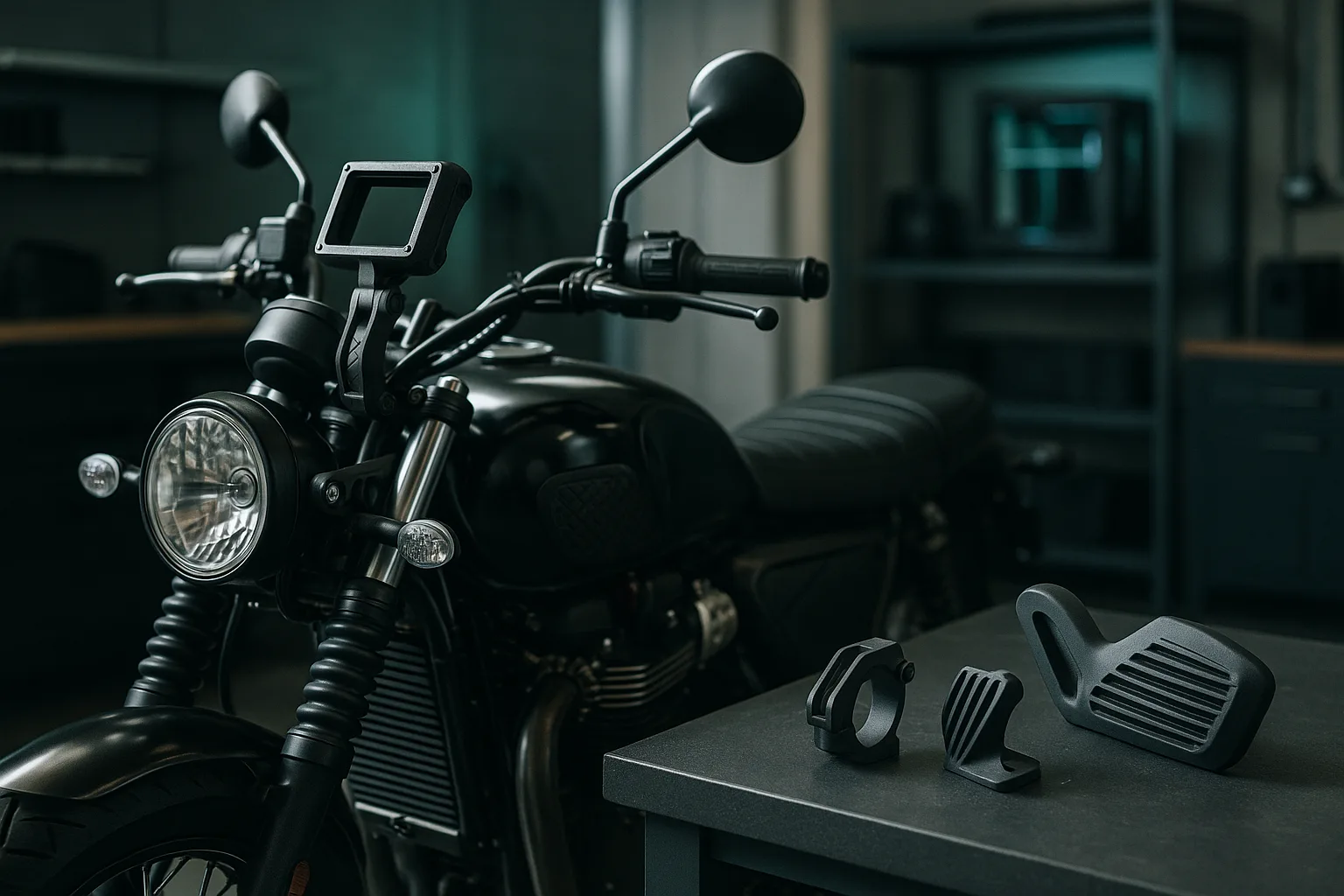
| GPS or phone mount | ASA, carbon-reinforced nylon | Measurements (handlebar diameter, hole spacing) |
| Bolt cover, plug | ASA | Measurements or photos |
| Cable gland, non-fuel hose guide | TPU, PETG | Measurements |
| Dashboard part, instrument surround | ASA, resin for fine detail | Scan |
| Decorative grip end | ASA, nylon | Measurements or photos |
| Licence plate mount | Carbon-reinforced nylon, ASA | Measurements |
| Prep or custom accessory | ASA | AI 3D Studio or scan |
| Anti-chafe protection, slider | TPU | Measurements |
For a licence plate mount, follow the regulations in force on the position, tilt and lighting of the plate: 3D printing doesn't exempt you from these rules.
Method A: scan the part
Motorcycle plastics are almost always curved: a side cover follows the frame, a deflector follows the line of the tank. A 3D scan is then the most reliable method. The workshop uses an industrial Creaform MetraScan scanner, accurate to around 0.1 mm.
A part broken in a fall is still usable: the pieces are glued back together before capture, or the torn-off area is completed by symmetry, since many motorcycle parts exist in left and right versions. Wear and warping are corrected during reconstruction, and fixing points are restored to the correct dimensions. Request a capture via the 3D scan page.
Scanning the mounting area for custom work
In prep work, the part often doesn't exist yet. The area of the motorcycle that will receive it is scanned instead: the frame under the seat for a custom cover, the fork head for a small windscreen, the top yoke for an instrument plate. The model is drawn directly onto this captured surface, which guarantees a solid fit and aligned fixings from the first try. For parts too large for a single print, the part is split into elements joined by interlocking and bonding, with seams placed where they're least visible. The workshop's large format can still print in one piece up to about 60 cm, in up to 8 colours, which covers most covers and small fairings without painting.
Method B: remake the part from measurements
For a mount, a plug, a cable gland or a bolt cover, a few measurements with calipers are enough. Measure:
- the diameter of the handlebar, tube or shaft the part attaches to;
- the hole spacing of the screws or rubber mounts;
- the available thicknesses and the surrounding clearance (steering travel, cable routing);
- the size of the screw head to cover for a bolt cover.
Then describe the part to the AI 3D Studio: it generates a parametric model whose dimensions are set with sliders. A GPS mount for a 22 mm handlebar can thus be adapted to a 28 mm handlebar without redrawing anything. The guide to writing the brief for a 3D part helps you phrase the request, and the one on tolerances and fits gives the clearances to plan for.
Method C: remake the part with AI from photos
For a simple part, Timelapse's AI can reconstruct the shape from 1 to 6 photos: front, side and top, with a ruler or an object of known size next to the part. You then adjust the functional dimensions with the sliders, or with natural-language tweaks, then export to STL or 3MF or order the print directly.
Plugs, end caps and bolt covers suit this method well. For a side cover or a fairing with complex curves, scanning remains more precise. The guide to AI 3D modelling explains how it works.
On a motorcycle, it's not usually the parts that break, it's their fixings. Plan for threaded inserts rather than a thread in the plastic, and a rubber washer or a rubber mount between the part and the frame: vibration will be absorbed instead of cracking the tabs.
Materials suited to two-wheelers
A motorcycle accumulates stresses. The choice of material depends on the location:
- UV and weather: ASA resists sun and rain, and is the default material for covers and fairings. PLA should be avoided: it warps in the sun and ages poorly outdoors.
- Vibration and impact: nylon and carbon-fibre-reinforced nylon handle repeated stress better, for mounts and plates.
- Heat: near the engine, the casing or the exhaust, a thermoplastic can soften. Keep parts away from heat sources and check the actual temperature at the intended location.
- Flexibility: TPU suits cable glands, sliders and anti-chafe protection.
- Oil, fuel, cleaning products: flag any such exposure in your request, as some materials don't hold up well against them.
The full comparison is in the guide to 3D printing materials, and the available materials are on the materials page. For a visible part, the guide to finishes and post-processing covers sanding and painting.
Limits and safety
On a two-wheeler, a failing part can cause a fall. Never print:
- braking parts (levers, master cylinders, caliper mounts);
- steering and suspension parts, as well as anything related to the road-holding system;
- essential controls such as throttle grips or levers;
- fuel and brake circuit parts (hoses, tanks, reservoirs);
- structural parts: rear subframe, footpeg mounting plates, engine mounts;
- approved lighting and signalling: headlights, indicators, reflectors;
- helmets and protective equipment.
Printed fairings and deflectors must remain non-structural. Vehicle approval and passing its roadworthiness inspection remain the owner's responsibility.
How to send a request
- Curved or broken part: request a capture via the 3D scan page and send the part, or its pieces, to the workshop in the Var.
- Simple part or accessory: open the AI 3D Studio, describe it with your measurements or upload your photos, adjust it, then order with an instant price. The 50 free credits cover the first attempts.
- Prep work or production run: specify the quantity, material, colour and exact location on the motorcycle.
Always specify the make, model and year, with photos of the part in place. The workshop has more than 20 machines (multi-material FDM, SLA resin, large format up to about 60 cm and 8 colours) and delivers across France. For a price estimate, see the guide to 3D printing prices. Do you also drive a car or a motorhome? See the guides to automotive parts and motorhome parts.
Frequently asked questions
Which material should you choose for a 3D printed motorcycle cover?
ASA is the usual choice: it resists UV, rain and moderate heat, and it can be painted. For mounts subject to vibration, carbon-fibre-reinforced nylon is preferred; for flexible parts, TPU.
Can you print a complete motorcycle fairing?
Small non-structural fairings and deflectors can be made, in one piece up to about 60 cm on the large-format printer, or in several assembled elements. A fairing that carries a headlight, a mirror, or that helps hold other parts in place should not be printed.
Can you print a licence plate mount?
Yes, provided you follow the regulations on the position, tilt and lighting of the plate. A well-sized carbon-fibre-reinforced nylon or ASA part can handle the vibrations. Compliance remains the owner's responsibility.
Can you remake a classic motorcycle part you can no longer find?
Yes. The part, even if broken or borrowed from another owner, is scanned, corrected for wear, then printed. Decorative parts can then be sanded and painted to restore the original look.